
How to Spot AI Writing in the Wild
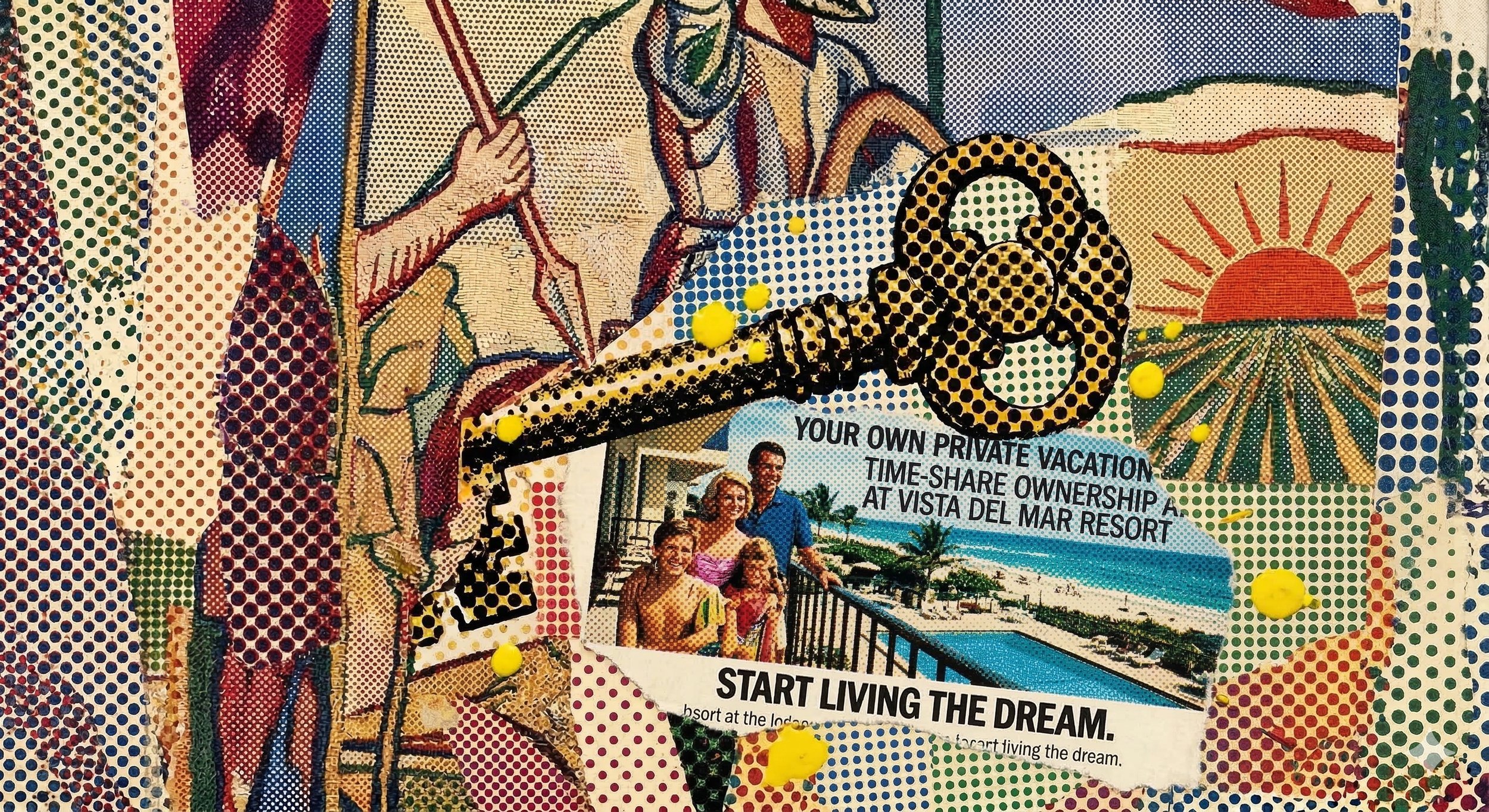
Nano Banana prompt: “Can you create an image of an extreme close up in the style of a giant James Rosenquist painting of a dot ink image of pivotal tapestry that underscores the intricate interplay of enduring keys and epic landscapes?
March 4, 2026
TLDR
The fact that someone has used an LLM to help with a project is no longer remarkable.Large language models like ChatGPT, Claude, and Gemini are new, sophisticated tools, but they are still just tools. In the same way the fact that someone might have used spellcheck to help polish a piece of writing, having used AI to help draft a piece is not reason enough to cast someone into the brainrot slop fires of hell.
HOWEVER, if someone is using these new, sophisticated tools in lazy, deceptive ways in order to produce hack work that wastes all of our time and energy, when what is required is quality work, well, then . . . do what you must.
The copy on the rip-off sites is *hilarious*:
— Dan Hon (@danhon.com) May 1, 2025 at 11:28 AM
[image or embed]
What?
"All writing," said Martin Amis, "is a campaign against cliché." And while Amis himself was not always a winner in this campaign, his framing remains a good way of thinking about writing, especially now when we have a whole new raft of clichés being generated at scale everyday thanks to AI.
A cliché, for Amis, is what happens to language when it loses its ability to convey information due to overuse. Like a car driven into the ground, a cliché can no longer get writer or reader from here to there.
This campaign against cliché has been around since the first little buzzing thing sent a smidge of information to a second little buzzing thing, and as long as information needs conveying, this campaign will go on. AI is merely the latest front in the forever war.
So in the same way you can tell someone might have used spellcheck but didn't actually read over their work if said work has consistent "its"/"it's" or "their/there" confusion, and/or you can tell if someone is not the best critical thinker if their research is *only* wikipedia links, you can also tell when someone is using AI as a replacement for, instead of a supplement to, good old fashioned human intelligence if you start to see the following patterns over and over.
And over. Again
These are phrases and constructions that have been generated so many times, across so many contexts, that the primary meanings they convey are no longer what they originally were. The primary meaning now is simply that the text was AI generated.
If you want to convey meaning beyond the fact that you used AI to generate copy, then here are some AI writing clichés, adapted from this continuously updated guide, to avoid.
(NB: these aren't "proof" of AI use (see above re: info smidges), but a cluster of these patterns in a single document is a strong signal that there hasn't been a cognizant human in the loop.)
Okay, so let's just get this one out of the way first.
Em-dash overuse
Apologies to Emily Dickinson and to all lyric, paratactic prose writers of the past 150 years, but AI has – temporarily! – killed the em-dash.
AI uses em-dashes constantly, in places where a comma or period would work, so now – goddamnit – a paragraph with three or more em-dashes, especially in punched-up "sales-like" constructions, is evidence of not a narrow fellow in the grass but a machine in the writing process.
Emojis as structural decoration
Sorry, LinkedIn Lunatics, but AI tools use emojis as organizational shorthand, placing them before bullet points, section headers, and key claims as a substitute for hierarchy and emphasis, so if your post looks like this:
🎯 Strategic Alignment
⚡ Crisis Management
Your tools are showing. Like all clichés, the emoji-as-header worked the first few times someone did it, but it no longer does anything but seem lazy.
In professional comms, emoji decoration signals that a tool, not a writer, organized the document, so if your work includes emojis in headers or before bullet points, and you did not put them there deliberately, take them out (same goes for **section headers** like ***this***).
Negative parallelism
This is now the most obvious tell I see. Constructions built on "it's not just about X, it's Y," or "not A, not B, just C" appear constantly in AI text, and, now, constantly in headlines and "summary" statements like these:
"The Seahawks didn't just win the Super Bowl. They did something even more challenging"
Negative parallelisms create the feeling of contrast and depth without delivering much of either, a lot like the pre-AI "You'll never guess what Charlie Sheen said about Thin Lizzy"-style headlines.
The giveaway here is that the negative and positive halves aren't actually in tension. The construction is doing rhetorical work the content hasn't "earned."
When you find a negative parallelism, it's useful to ask (attn: NYT sports desk!) whether the contrast is real. If it isn't, replace the whole construction with a direct statement.
Empty vocab
AI models overuse a specific set of words like pivotal, crucial, vibrant, tapestry (used abstractly), landscape (used abstractly), testament, underscore, highlight, showcase, fostering, garnered, enhance, intricate, interplay, align with, enduring, key (as a general adjective).
Like the em-dash, a few of these aren't remarkable, but four in one paragraph is a tell, so careful with your pivotal tapestry that underscores the intricate interplay with enduring zzzzzzz.
Promotional language
AI defaults to the register of median advertising, so: groundbreaking (used figuratively), stunning, boasts a, continues to captivate, enduring legacy… all that sort of pre-chewed slop that slides right off the brain. Yuck.
If a sentence sounds like a hype email from a time-share or an Amazon product description, it probably came from a model trained on both. It was always good practice to cut empty phrases like these, and now more than ever.
"Elegant" variation
AI tools are designed to avoid using the same word twice, which isn't terrible writing advice, but it can get a little weird when overused. A passage that refers to the same person or thing as "the activist," then "the organizer," then "the campaigner," then "the advocate" in four successive sentences might be a feature for the bot, but it's a bug for the human reader. Just stick with whatever is most apt the first time around.
The mechanical rule of three
I love three-item lists, but alas, like the em-dash, LLMs have spammed them into mere rhythmic sounds that convey little meaning. Tripartite runs like "Keynote sessions, panel discussions, and networking opportunities," are AI's way of making thin content look comprehensive, just like it was when I would use it writing autopilot organizational statements (sorry!).
When you find a three-item list, ask whether the three items are meaningfully distinct, or whether you could just cut to the strongest one. Or, hell, go for four items! Live a little! While you can!
"It's important to note"
Any sentence that begins with "it's important to note," "it's crucial to remember," "at the end of the day," or "it's worth mentioning" is hiding the point behind a disclaimer. If the piece is a script to be read aloud, then these can be helpful signals, but in writing to be read, they're just filler. Better to cut.
"In summary / In conclusion"
Despite what your high school teacher may have said, a section that ends by restating its own opening adds nothing to the overall argument. Like a solid B- student, AI appends these summaries routinely. If you find one, cut it and move the argument forward, or actually wrap it up.
So What?
According to a recent Gallup poll, nearly half of public-sector employees in Q4 2025 reported using AI at least a few times a year. That’s up from 17% of public-sector employees in Q2 2023, and it’s now more than private sector employees, who are at 41%.AI executives and researchers “readily admit that they have not yet released a model that writes well,” Jasmine Sun writes. She speaks with AI experts about why LLMs are built in a way that is antagonistic to great writing:
— The Atlantic (@theatlantic.com) March 19, 2026 at 1:15 AM
[image or embed]
This number means a lot of the people sending pitches, reports, statements, and coalition materials are using AI to write them. Some way more than others. And by July, I bet the vast majority of comms people across the non-profit world will be using AI in some capacity to produce their public-facing written materials. So it’s more important than ever to be able to recognize when it's being used badly.
Hacky AI writing undermines credibility. Not because it’s morally wrong or more likely to be factually wrong than hack human writing. Hacks are gonna hack. And, as it always has, hack writing in whatever form is generic. It conveys nothing, and it could have come from anyone. It’s a blob of cliches.
Because LLMs were born of bureaucracy, they are fluent in bureaucratic cliche. And, to be fair, sometimes
bureaucratic cliche is what people want. Our best work, though, should be work that could only come from us.
When AI cliches seep into our work, readers notice, and these readers, even if they can't name the problem, feel the absence of intelligent, specific choices being made for them, and they tune out.
If anyone's curious, I've moved the full playlist of Chat Orpheus Poems, my collaborations with ChatGPT, to YouTube (Bye TikTok!)
I'd love to keep the conversation going, so if you have any suggestions for starter words, prompts, or personas, let me know!
youtube.com/playlist?lis...
Now What?
[image or embed]
Ideally, every communication should be impossible to attribute to any other organization or person. Airlift a random paragraph or sentence out of a press release, and someone should be able to say, “Ah, yes! The Coalition to Empower Defunding Militarized Shellfish Classification! I’d know it anywhere!”
If a statement we send could have come from anyone, it might as well come from no one. Though, of course, sometimes content doesn’t have to be good content. Sometimes, you’re just producing bureaucratic pap to be fed into the bigger machine. That’s when AI is super useful.
But if you’re any good, you’ll want to know the difference between pre-chewed slop and actual writing.
If we’re going to keep our humanity, we have to keep honing our ability to make the good stuff, and we do this by continuing the campaign against cliche, in whatever form it takes.
Have other tells or tip-offs? Tell me
